

Acoustic louvers
Where air has to cross a wall that is holding noise in, a louver does both jobs — if its free area and its attenuation are balanced properly.
Also in this branch
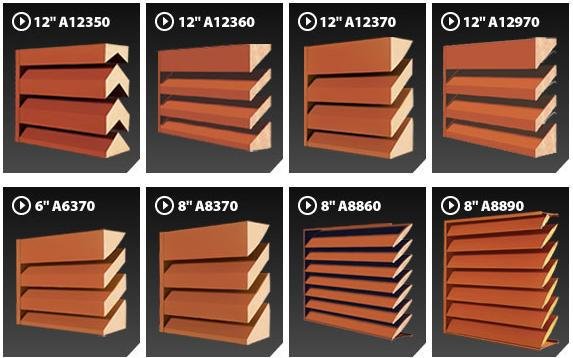
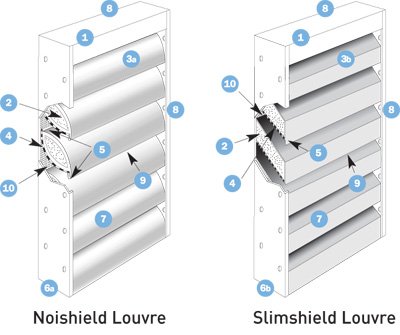
An acoustic louver is a bank of absorptive blades: air passes between them while sound is absorbed along the way. The deeper the blades, the more attenuation — and the more resistance to airflow. Get that balance wrong and you either starve the plant of air or let the noise straight out.
Where they are used
- Generator and plant room walls.
- Ventilation openings in facades, where outside noise would otherwise enter.
- Enclosure inlets and outlets.
- Screens around roof-mounted plant.
- Cooling tower and chiller compounds.
Specifying one
| Airflow required | Sets the free area needed — the starting point for everything else. |
|---|---|
| Pressure available | How much resistance the fan can overcome. |
| Attenuation required | Sets blade depth; deeper blades cost free area. |
| Opening size | Enlarging the opening is usually cheaper than deepening the blades. |
| Weather | Drainage, bird and insect mesh, and finish for exposure. |
| Material | Galvanised, aluminium or stainless, with a finish to suit the facade. |
What we need to quote
- Airflow and the pressure the fan can give up.
- Attenuation required, and what is on the other side.
- Opening size available, and the depth that can be accommodated.
- Exposure and finish requirements.
- Whether the opening also has fire or security requirements.
Tell us the room
Send dimensions and intended use. You get back an indicative acoustic treatment, a systems outline and a budget range.